
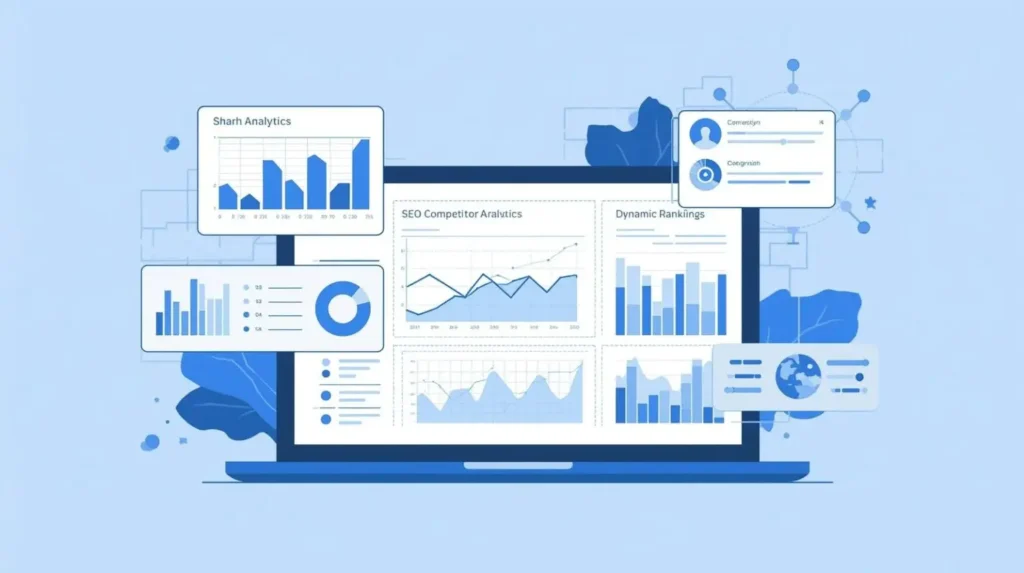
SEO COMPETITOR
TOOLS:A COMPLETE
GUIDE TO ANALYZE&
OUTRANK YOUR
COMPETITORS
What Are SEO Competitor Tools?
SEO competitor tools are platforms designed to help you analyze the strategies of websites that rank higher than yours on search engines. Instead of relying on guesswork, these tools provide real data about what’s already working in your niche.
They allow you to examine competitor keywords, backlinks, content performance, traffic sources, and overall SEO strength. With this information, you can build smarter strategies based on proven results.
Using SEO competitor tools, you can:
- Find keywords your competitors are ranking for
- Study their backlink sources
- Understand their content approach
- Identify gaps and opportunities you can target
Why SEO Competitor Analysis Matters
Doing SEO without competitor analysis is like entering a race without knowing your opponents. Competitor analysis gives you a clear picture of the landscape before you invest time and effort.
Here’s why it’s important:
- Helps you discover valuable keywords you may have missed
- Prevents you from targeting overly competitive keywords
- Shows which content types perform best
- Reveals backlink opportunities more quickly
- Enables you to create better content than existing results
The goal isn’t to copy competitors, but to outperform them using smarter strategies.
How to Identify Your Real SEO Competitors
A common mistake beginners make is focusing on business competitors instead of SEO competitors. Your true SEO competitors are the websites ranking for the keywords you want to target.
You can identify them by:
- Searching your main keywords on Google and noting top-ranking sites
- Using SEO tools to find “organic competitors”
- Observing websites that consistently rank for multiple related keywords
Interestingly, these competitors may not sell the same products but still compete for the same search traffic.
Types of SEO Competitor Tools
SEO competitor tools can be categorized based on the kind of insights they provide.
1. Keyword Research Tools
These tools help you discover keywords your competitors rank for that you don’t.
They provide insights such as:
- Organic keywords
- Keyword difficulty
- Search intent
- Ranking positions
This helps you identify keyword gaps and new opportunities.
2. Backlink Analysis Tools
These tools show where competitors are getting their links from.
You can analyze:
- Referring domains
- Link quality
- Anchor text usage
- New and lost backlinks
This data helps you build a stronger and more natural link profile.
3. Content Analysis Tools
Content-focused tools reveal which pages perform best for your competitors.
They help you understand:
- Content length and depth
- Topic coverage
- Page structure
- User intent
With this knowledge, you can create more valuable and optimized content.
4. Traffic & Performance Tools
These tools estimate competitor traffic and show how users interact with their websites.
They provide insights into:
- Organic vs. paid traffic
- Traffic sources
- Audience behavior
- Geographic distribution
This gives you a broader view of competitor performance.
Best SEO Competitor Tools in 2025
Here are some of the most trusted tools used by SEO professionals:
SEMrush
A comprehensive tool widely used by marketers and agencies.
Key features:
- Keyword gap analysis
- Competitor tracking
- Backlink comparison
- Content research
Ahrefs
Known for its strong backlink database and SEO insights.
Key features:
- Keyword research
- Backlink analysis
- Top-performing pages
- Content gap identification
Ubersuggest
A beginner-friendly and budget-conscious option.
Key features:
- Keyword ideas
- Domain overview
- Backlink data
- Content suggestions
SpyFu
Focuses on both SEO and paid advertising insights.
Key features:
- Competitor keyword history
- Ranking trends
- PPC and organic data
SimilarWeb
Best for understanding traffic patterns and audience behavior.
Key features:
- Traffic estimates
- User demographics
- Engagement metrics
- Traffic sources
Free SEO Competitor Tools for Beginners
If you’re just starting, you can still perform basic competitor analysis using free tools:
- Google Search (manual SERP analysis)
- Google Keyword Planner
- Google Trends
- Google Search Console
- Google Alerts
While these tools are limited compared to paid options, they are great for learning the basics.
Step-by-Step SEO Competitor Analysis
Follow this simple process:
Step 1: Identify competitors
List 5–10 websites ranking for your target keywords.
Step 2: Analyze keywords
Find what keywords they rank for and spot gaps.
Step 3: Study top content
Review structure, depth, and intent of their content.
Step 4: Analyze backlinks
Identify quality link sources you can target.
Step 5: Find content gaps
Look for topics they missed or didn’t cover well.
Step 6: Build a better strategy
Create content that is more useful, detailed, and optimized.
Repeat this process regularly for best results.
Common Mistakes to Avoid
When using SEO competitor tools, avoid these errors:
- Copying competitor strategies blindly
- Ignoring search intent
- Focusing only on traffic numbers
- Building low-quality backlinks
- Not updating your research
Success comes from combining data with originality.
SEO Competitor Analysis Checklist
Before publishing content, make sure you:
- Analyzed competitor keywords
- Understood search intent
- Identified content gaps
- Reviewed backlinks
- Improved content quality (not copied)
- Optimized on-page SEO
Why SEO Competitor Tools Are Important
In today’s SEO landscape, success depends on making data-driven decisions. SEO competitor tools help you understand what works, what doesn’t, and where opportunities exist.
Instead of guessing, you can rely on real insights to guide your strategy. Whether you’re a beginner, freelancer, or business owner, these tools give you a competitive edge.
When used effectively, they don’t just help you compete—they help you succeed in search rankings.